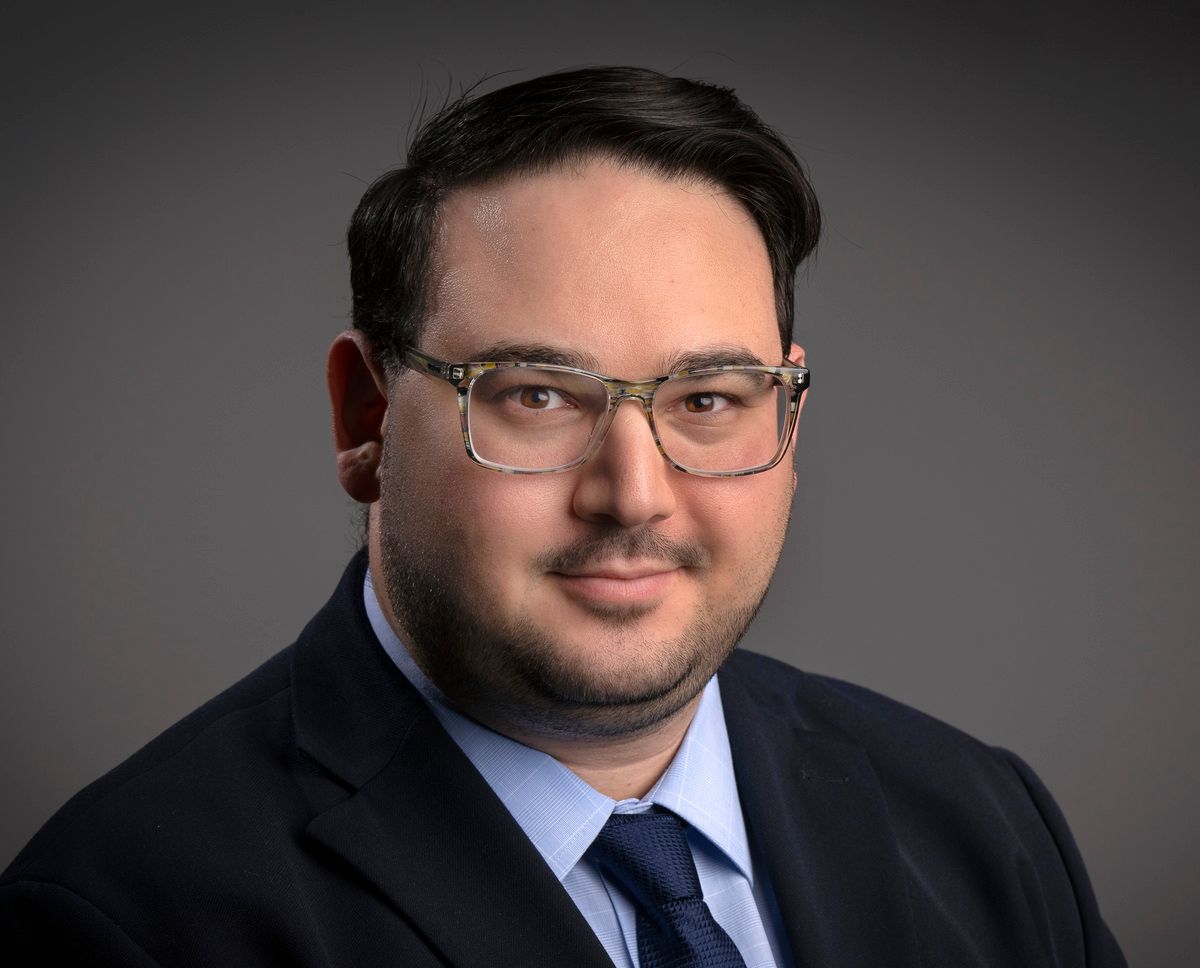

The cordoned-off security perimeter blocks from the Washington Hilton, and Weijia Jiang of CBS News, announcing the event would be postponed after the shooting.
Saturday was my first White House Correspondents’ Association dinner, and my first observation upon entering the Washington Hilton was the security.
It was, frankly, lighter than I expected. At one checkpoint, I flashed an envelope with my invitation inside. At another, I waved my invitation in front of an usher from a distance. At others, I was not asked to show a credential.
I walked through the main level past the hotel bar. Patrons, most of whom did not seem to be fans of either the press or President Trump, kibbitzed with dinner guests or just glowered at us.
Down an escalator, one officer patrolled with a German shorthaired pointer, white with liver-colored spots. A German shepherd carried around a rope toy.
When I arrived at the magnetometers outside the basement ballroom, the agents were eager to keep the line moving.
An officer in a Kevlar vest gave me a toothy grin when I remembered the pen in my pocket, placed it on a table, and proceeded without tripping the alarm.
Inside the ballroom, the mood was both convivial and apprehensive. Word was that President Trump was going to use his speech to assail the media, one of his favorite pastimes. The assembled journalists considered how to absorb the verbal barrage. Sit through it? Get up and leave?
Journalists and their guests weighed the options while munching on greens, pea shoots and burrata with balsamic vinaigrette.
The Hilton ballroom is huge and cavernous and hot. The arched ceiling funnels sound to the center of the room. Part of the Reuters contingent at the event sat a handful of rows from the stage, just to the left. I sat with another contingent 50 yards away to the right.
I finished my salad and mulled some bread and butter. Waiters prepared platters to serve chateaubriand and Maine lobster, then opera cake for dessert. I saw their heads snap to the center of the room, then heard the clatter of plates and glasses. I turned and saw plainclothes officers burst from their seats and tackle Cabinet officials and certain lawmakers to the floor.
Vice President JD Vance was whisked offstage immediately. Trump crouched slightly, but sat mostly exposed. Secret Service agents reached him moments later, covering his head as he stole glances toward the center of the room.
More agents swarmed in from side doors along the ballroom’s exterior. Others in full combat dress and carrying long guns sprinted onto the stage and trained their rifles on the crowd, scanning for threats.
This was a roomful of reporters. Attendees ducked for cover, then started searching for WiFi to begin reporting. The password for the event’s network was “MOREWINE.”
It was a moving thing to watch. My Reuters colleague and photojournalist Evan Vucci, seated at my table, took off to the center of the ballroom and started capturing images with his phone.
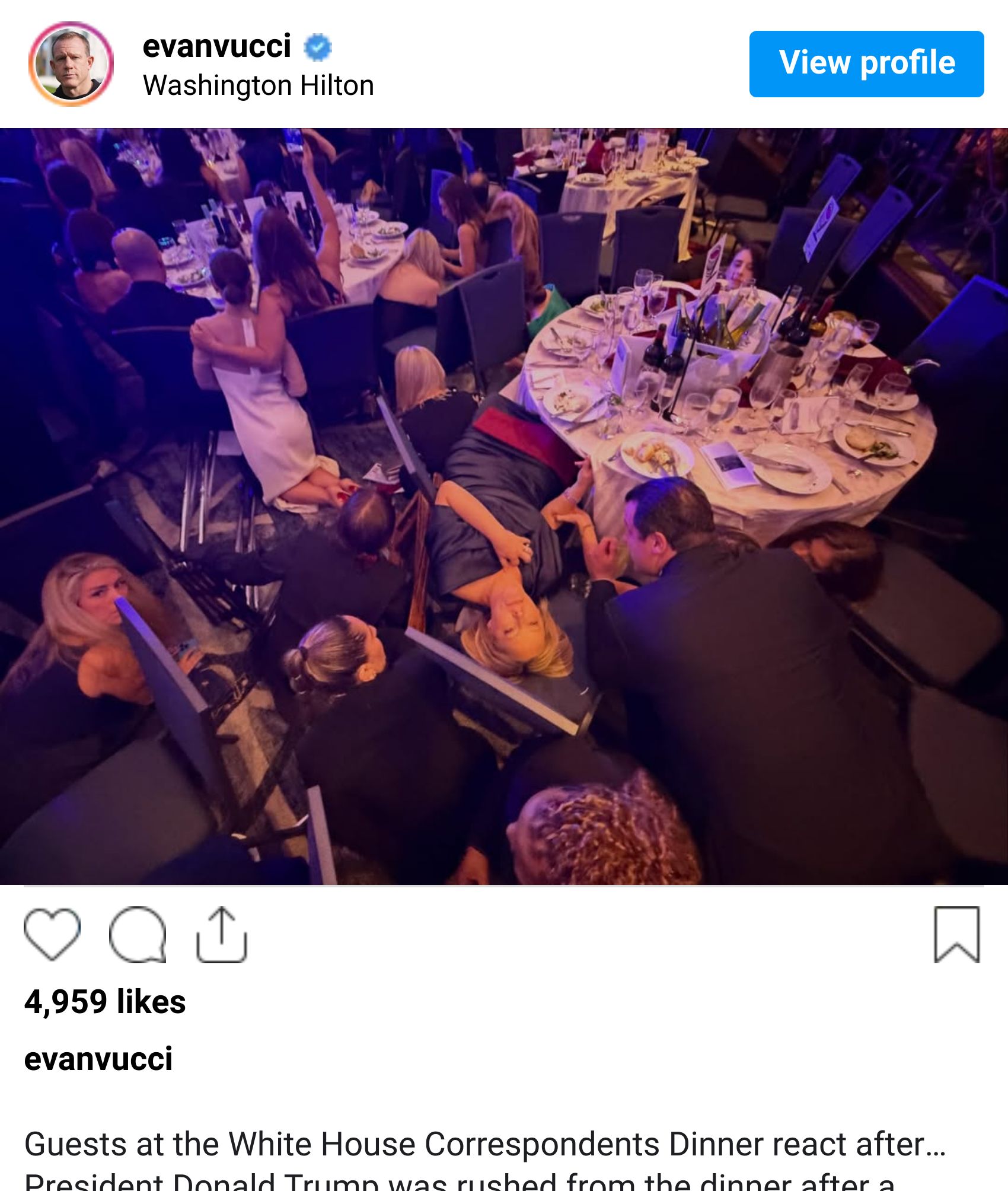
Reuters reporters clustered and started breaking out story ideas, eventually finding one another in the middle of the mayhem, half the conversation happening on Microsoft Teams, half shouted to one another.
I texted my wife: “There might have been an assassination attempt here. Hi I’m safe.”
I texted her, my parents and brother: “I AM SAFE I AM WORKING PLS DONT RESPOND”.
I started texting sources, but was quickly assigned to write what’s called a “color” story, presenting the scene in cinematic detail. I took down my own observations, then turned on a recorder and gathered observations from my colleagues: what they heard, saw, smelled, said, touched and felt.
(On Sunday, I wrote about how Trump is portraying the shooting as proof of the power of his presidency: “We've changed this country, and there are a lot of people that are not happy about that,” he said.)
I walked the circumference of the ballroom, mostly in silence, just taking it all in. When we evacuated, I hoofed it around the new security perimeter, a mile and a half back to my car, and drove it like I stole it back to the Reuters bureau.
When I arrived, Trump had stepped to the podium in the James Brady Briefing Room, named for President Reagan’s press secretary, who was shot during an assassination attempt at the same Washington Hilton in 1981.
I watched his press conference, then started filing. I paused to do a quick interview for Reuters’ podcast (you should add it to your rotation; it’s great) and by the time I looked up, it was 2 a.m. I pulled into my garage at 3:09.
One of the magical moments about doing journalism in situations like these is the look you give one another at the end of the night. It’s half “I really don’t want to do this again tomorrow and neither do you,” and half “I’ll be up early and ready to go.”
It’s the holy sacrifice that we make as journalists — less a vocation than a calling. These moments are indescribably unpleasant. And they’re immensely meaningful.
I will, I imagine, be doing a lot more coverage of this assassination attempt. On top of the usual questions about how and why this happened, the president and some of his supporters are arguing this shooting is proof that the White House needs a new $400 million ballroom.
That kind of federal spending — even if the money comes from private donors — is squarely on my economic policy beat.
What do you want to know? Send me a note at [email protected]. and contact me securely on Signal at jacobbogage.87. And follow me on Bluesky (@jacobbogage.bsky.social) and LinkedIn.
And while I have you here, remember to take care of yourself. This stuff is heavy for all of us. Be kind to yourself and those around you. And if you’re not allergic, go pet a dog.